


The performance of tracked vehicles depends heavily on how their tracks interact with the soil beneath them. Traditionally, understanding this interaction required extensive field testing and multiple physical prototypes, often leading to significant development costs and lengthy validation cycles. Today, engineers can simulate realistic operating conditions virtually using Computer-Aided Engineering (CAE), enabling faster, more informed design decisions.
This article explores how coupled simulation technology is used to analyse track-to-soil interaction, providing valuable insights into machine behaviour, structural loading, soil deformation, and long-term durability.
Why Track-to-Soil Interaction Matters
When a tracked vehicle moves across soft ground, several complex physical processes occur simultaneously:
- The track transfers vehicle weight into the soil.
- Soil particles compress, deform, and shift.
- Loads are distributed unevenly across track components.
- Dynamic forces continuously change during acceleration, braking, turning, and manoeuvring.
- Structural components experience varying levels of stress and fatigue loading.
Accurately predicting these interactions is essential for improving machine stability, reducing component wear, optimising track design, preventing structural failures, extending service life, and improving operator safety.
Because these interactions involve both mechanical systems and deformable materials, traditional analytical methods often struggle to capture the full picture. This is where coupled CAE simulation becomes invaluable.
The Coupled Simulation Approach
To replicate real-world operating conditions, the study combines two powerful simulation technologies:
- MotionSolve – Multi-Body Dynamics: MotionSolve is used to model the complete kinematic behaviour of the tracked excavator, including track movement, suspension behaviour, component interactions, dynamic load transfer, and flexible body stresses. This enables engineers to understand how the machine moves and how loads are transmitted through its structure.
- EDEM – Discrete Element Method (DEM) – EDEM represents the soil using thousands or even millions of individual particles. Instead of treating soil as a continuous material, DEM simulates particle-level behaviour, allowing realistic prediction of soil compaction, particle displacement, ground deformation, contact forces, and material flow patterns.
By coupling MotionSolve with EDEM, engineers can simulate both the vehicle and the terrain simultaneously, creating a highly realistic virtual environment.
Case 1: Excavator Moving Across Soft Soil
The first simulation scenario examines a tracked excavator travelling forward across a soft soil surface. Although the terrain in this example is modelled as a flat soil bed, the same approach can be extended to more challenging environments, including uneven ground, slopes, loose aggregate, muddy terrain, construction sites, and mining surfaces.
As the excavator advances, the coupled simulation calculates how the soil responds to the track loading and how those resulting forces affect the track system.
Key insights generated from this coupled simulation are:
1) Soil compaction analysis to determine whether the vehicle can operate effectively on soft terrain without excessive sinking or loss of traction.
2) Track structure stress distribution to improve structural robustness while avoiding unnecessary weight increases.
3) Realistic force extraction to calculate a highly accurate representation of real-world loading conditions.
Stress distribution on track structure
Soil compaction
Case 2: Slew Turn Analysis
Forward travel is not the only operating condition for tracked machinery.
The study also demonstrates a slew-turn simulation, where the excavator performs turning manoeuvres while interacting with the soil.
As turning introduces additional complexities, such as increased lateral forces, soil shearing, uneven track loading, and greater structural stress variation, analysing these conditions helps engineers evaluate machine performance during realistic site operations where turning and manoeuvring occur continuously.
Rendered Animation of Coupled EDEM– MotionSolve Simulation
Beyond the Understanding of Machine Motion
In addition to the outputs generated by the initial simulation, it is possible to request additional data for subsequent analyses and integration with other software. One example is the extraction of forces at all connection points within the track structure. These forces can then be used in Optistruct to perform a detailed structural assessment of the system.

HyperView Image of Optistruct Simulation
The extracted loads can be selected from a specific time window within the coupled simulation and transferred directly into a load deck.
In the example shown below, a 1-second time window was used, spanning from 9 to 10 seconds. Force readings were recorded at intervals of 0.05 seconds, resulting in a total of 21 load cases. The results can either be visualised individually across all 21 load cases or presented as a single plot to display all load cases simultaneously.
The forces can also be output as a time-series response and incorporated into a fatigue assessment. This approach uses stress superposition to combine time-series data with a unit load analysis of the structure, enabling a highly accurate prediction of fatigue life.
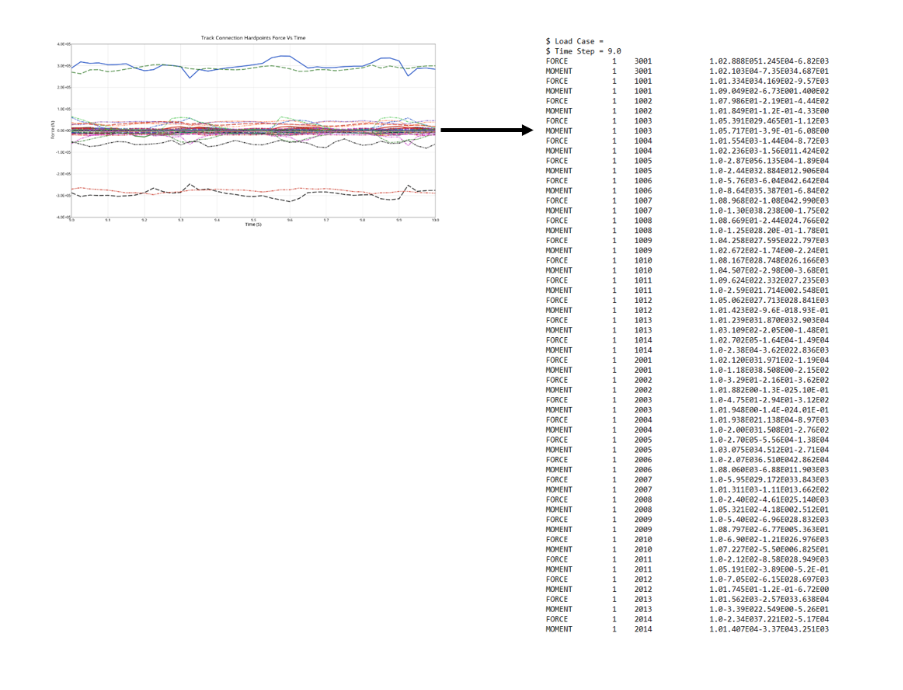
Left: HyperGraph image of extracted loads | Right: Optistruct image of load case timestep
Conclusion
Track-to-soil interaction is one of the most challenging aspects of tracked vehicle engineering due to the complex relationship between machine dynamics, structural behaviour, and ground mechanics. By coupling MotionSolve and EDEM, engineers can accurately replicate these interactions within a virtual environment, gaining insights that would be difficult, expensive, or sometimes impossible to obtain through physical testing alone.
From soil compaction and stress distribution to fatigue life prediction and structural hotspot identification, the approach provides a comprehensive understanding of vehicle performance under real-world operating conditions. As industries continue to demand faster development cycles, higher reliability, and reduced costs, coupled simulations are becoming an essential part of modern off-highway vehicle engineering.
In short, virtual track-to-soil simulation is a strategic enabler for building safer, more durable, and more efficient machines.